Why Choose Marine Copper Casting for Global Shipbuilders?
Global shipbuilders need components that survive saltwater, vibration, pressure, and long maintenance cycles. Marine Copper Casting supports this demand through corrosion-resistant alloys, controlled solidification, and dependable dimensional accuracy. Propeller hubs, seawater pump bodies, valve parts, and heat-exchanger components often depend on these properties.
The UNCTAD Review of Maritime Transport 2024 recorded approximately 12.3 billion tonnes of seaborne trade in 2023. That scale highlights the harsh operating environment facing modern vessels. The International Copper Study Group’s Copper Market Forecast, October 2024, also shows refined copper demand remaining above 26 million tonnes annually. Demand is not the whole story. Alloy selection and casting quality decide whether copper performs reliably offshore.
Merton C. Flemings, an internationally recognized casting authority, wrote, “Casting is the most direct route from liquid metal to a finished product.” His observation remains relevant to marine manufacturing. Proper mold design can reduce machining, material waste, and production time. However, casting is not automatically reliable. Gas porosity, shrinkage, inclusions, and uneven cooling can weaken a critical part.
Experienced foundries therefore combine spectrographic alloy verification, controlled pouring, heat treatment, and non-destructive testing. Classification requirements from organizations such as ABS, DNV, and Lloyd’s Register add another layer of confidence. Yet standards cannot replace careful process control. A polished surface may hide internal defects.
For global shipbuilders, the strongest case for Marine Copper Casting is practical: corrosion resistance, repairable supply chains, and proven compatibility with demanding marine systems. The choice still requires evidence from test certificates, traceability records, and service experience. Sometimes, the less obvious detail matters most.
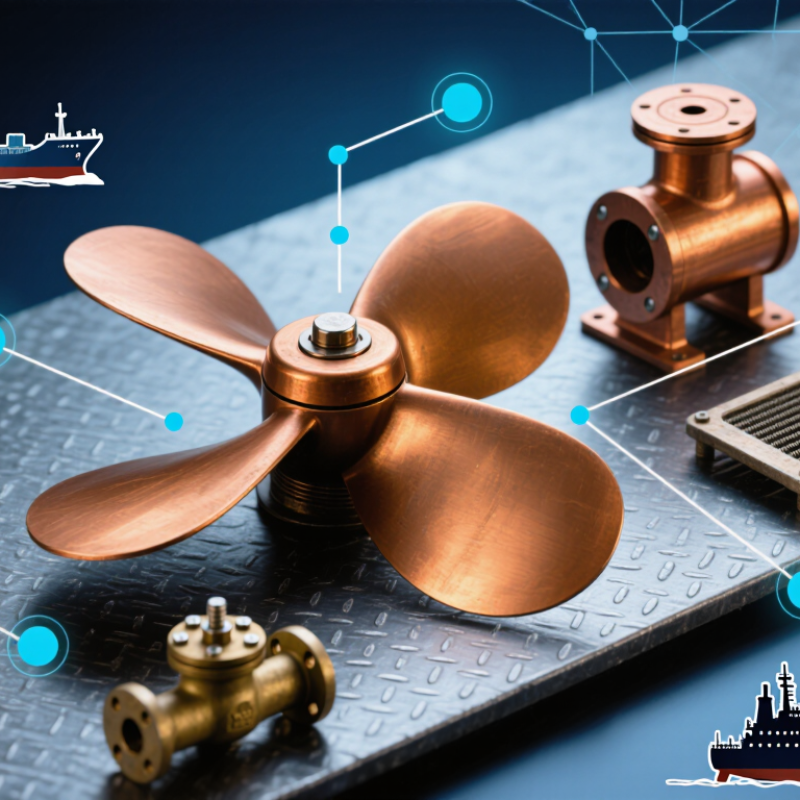
Marine copper casting remains important for shipbuilders because seawater systems demand strength, corrosion resistance, and stable dimensions. Copper-nickel alloys meet these needs without relying on fragile protective coatings. Yet alloy selection deserves careful attention. The wrong grade can increase maintenance, casting defects, and lifecycle costs.
The 90/10 Cu-Ni alloy contains approximately 90% copper and 10% nickel. It suits seawater piping, coolers, valves, and moderate-flow components. Its thermal conductivity supports efficient heat transfer in compact marine equipment. Proper surface conditioning also helps it resist marine growth. Keep it clean. Poor welding practices or iron contamination can damage performance.
The 70/30 Cu-Ni alloy offers higher nickel content and stronger resistance to high-velocity seawater, turbulence, and erosion. Shipbuilders often consider it for seawater pumps, condensers, and demanding circulation systems. However, it costs more and may require tighter control during melting, pouring, and machining. A casting can look flawless while hidden porosity weakens pressure performance. Chemical analysis, dimensional checks, radiographic inspection, and pressure testing provide stronger evidence than appearance alone. The economical choice is not always the cheapest alloy. In practice, flow speed, temperature, oxygen levels, and repair access should guide the decision. This is where design assumptions sometimes fail.
Seawater is unforgiving. Salt, oxygen, flow, and marine growth attack exposed metal continuously. Copper-nickel castings offer a strong defense for seawater pumps, valves, strainers, and pipe fittings. Technical guidance from the Copper Development Association reports uniform corrosion rates of roughly 0.0025–0.025 mm/y for established copper-nickel surfaces in clean, aerated seawater. That is far below many conventional marine alloys.
The protective film develops gradually. It contains stable copper compounds and reduces further metal loss. This matters inside a casting, where complex passages can be difficult to inspect. Industry material-selection guidance, including ISO 21457, still requires project-specific corrosion allowances. The rate is not a promise.
Early exposure can look worse.
Shipyards should control welding heat, surface contamination, and water velocity. Sulfide pollution, stagnant pockets, and severe impingement can damage the protective layer. Technical reports on copper-nickel seawater systems also warn that newly installed components may need careful commissioning. A poorly cleaned casting can perform below expectations, even when its alloy chemistry is correct. That detail is easy to overlook.
Experienced builders therefore review casting quality, heat treatment, dimensional accuracy, and service conditions together. Marine copper casting is not simply a material choice. It is a maintenance decision, a fluid-flow decision, and sometimes an uncomfortable test of installation discipline.
Why Choose Marine Copper Casting for Global Shipbuilders?
Marine copper casting supports ship components exposed to seawater, pressure, vibration, and repeated temperature changes. ASTM B148 covers aluminum-bronze sand castings, often selected for valve bodies, pump casings, and marine fittings. Its strength and resistance to seawater erosion make it useful where steel may corrode quickly. Still, alloy selection must match velocity, pressure, galvanic conditions, and service temperature.
ASTM B171 applies to copper-alloy plate, sheet, and circles for pressure vessels, condensers, and heat exchangers. These products require controlled chemistry, mechanical testing, and dimensional inspection. A plate near a condenser tube sheet may look sound, yet internal discontinuities can create trouble during machining. Testing matters. Traceable heat numbers, tensile results, and thickness records help connect each part to its production history.
ASTM B584 covers copper-alloy sand castings for general applications. It can support brackets, covers, housings, and less pressure-critical marine components. However, B584 is not a universal approval for every seawater part. This is where practical judgment matters. Foundry teams should review casting drawings, gating design, shrinkage risk, and final inspection methods together. Even experienced engineers can over-trust a certificate. A clean surface is not proof of a flawless casting. Radiographic or penetrant inspection may reveal problems hidden beneath a smooth finish. Shipbuilders should also confirm the applicable vessel rules and project specifications before production, because ASTM compliance alone may not satisfy every marine installation.
| ASTM specification | Primary product form | Material scope | Marine component examples | Typical selection value | Key verification points |
|---|---|---|---|---|---|
|
ASTM B148 Aluminum-Bronze Sand Castings |
Sand castings | Aluminum-bronze copper alloys supplied as castings. The specification covers chemical composition and applicable mechanical and manufacturing requirements for listed alloy grades. | Valve bodies, pump components, propeller-related parts, bearing housings, wear rings, and other heavily loaded cast components. | Useful where a cast aluminum-bronze alloy is required for strength, wear resistance, and resistance to many seawater service environments. | Confirm alloy grade, casting process, heat treatment where specified, mechanical test results, dimensional tolerances, and any supplementary non-destructive examination requirements. |
|
ASTM B171 Copper-Alloy Plate, Sheet, and Circles |
Plate, sheet, and circles | Wrought copper-alloy products intended for pressure vessels, condensers, and heat exchangers. It is not a sand-casting specification. | Heat-exchanger components, condenser parts, pressure-vessel elements, tube-sheet-related applications, and fabricated marine equipment. | Appropriate when the component requires wrought plate or sheet with controlled composition and mechanical properties for thermal or pressure-service applications. | Confirm product form, alloy designation, thickness or diameter range, temper, tensile properties, yield or proof strength where applicable, elongation, and inspection requirements. |
|
ASTM B584 Copper Alloy Sand Castings for General Applications |
Sand castings | Copper-alloy sand castings for general applications, including multiple alloy families and grade-specific chemical composition requirements. | General valve and pump bodies, pipe fittings, covers, brackets, marine hardware, and cast parts where the engineering specification identifies a suitable alloy grade. | Provides a broad framework for copper-alloy sand castings when the required service performance is defined by the selected alloy and project specification. | Confirm the exact alloy grade, chemical limits, tensile requirements where applicable, casting condition, repair restrictions, dimensional criteria, and service-specific corrosion requirements. |
Copper alloys can combine useful electrical and thermal conductivity, castability, wear resistance, and corrosion performance. The actual suitability depends on alloy grade, seawater chemistry, flow velocity, temperature, biofouling conditions, and galvanic compatibility.
An ASTM specification defines material and product requirements; it does not by itself replace design calculations, classification-society rules, pressure-equipment requirements, welding procedures, or project-specific inspection plans.
State the ASTM edition, alloy designation, product form, dimensions, mechanical requirements, heat treatment, surface condition, inspection level, certification documents, and any additional non-destructive testing in the purchase order.
Marine copper casting matters when seawater flow becomes aggressive around propellers, pumps, valves, and intake systems. Cu-Ni alloys can support flow speeds up to 3.5 m/s when the alloy grade, casting quality, and system design are properly matched. This capability helps reduce turbulence-related wear in high-flow seawater circuits. It also supports stable performance near bends, narrow passages, and partially loaded sections.
In practical shipbuilding, engineers examine more than nominal speed. They check cavitation risk, pressure changes, wall thickness, surface finish, and local turbulence. A rough casting surface can disturb flow and create small regions of accelerated corrosion. Careful mold control, heat treatment, and dimensional inspection therefore matter. So does installation accuracy. A misaligned component may cancel the advantages of a well-selected alloy.
Testing should reflect real service conditions, including seawater temperature, salinity, suspended particles, and operating cycles. Hydraulic trials can reveal pressure loss that drawings may not show. Field experience suggests that 3.5 m/s is a design boundary, not a universal guarantee. Some installations need lower velocities because vibration, geometry, or maintenance limits change the result. That detail matters. Engineers should review inspection records and test data before approving a casting for global shipbuilding projects. Mistakes are possible, especially when laboratory assumptions differ from a vessel’s actual route and loading pattern.
Circular supply chains are changing how marine copper castings are produced. In well-managed recovery programs, copper recycling rates can approach 90 percent. The exact figure depends on sorting, contamination, and return logistics. Clean sprues, runners, and rejected fittings can go back into controlled melting cycles. This reduces demand for newly mined copper.
A foundry floor shows the process clearly. Workers separate copper alloys before charging the furnace. Portable analyzers check composition within minutes. Accurate records then connect each batch to its origin and test results.
This discipline matters because seawater service exposes components to corrosion, vibration, and fatigue. Recycled metal must still meet strict chemical and mechanical requirements.
The circular model also benefits shipbuilders. Shorter material routes can reduce waste, storage pressure, and production delays. However, recycling is not automatically sustainable. Mixed alloys can lower quality and increase processing energy.
I would question any 90 percent claim without clear measurement boundaries. Does it include only factory scrap, or recovered parts from retired vessels? That distinction deserves attention.
Reliable suppliers should share inspection data, melting controls, and recovery methods, not just attractive percentages.