How to Choose Investment Casting Parts for Your Project?
Choosing the right Investment Casting Parts can significantly impact your project’s success. According to industry expert John Smith, "Precision in investment casting leads to success." This highlights the importance of understanding the nuances involved in selecting these crucial components.
Investment Casting Parts are used in various industries, from aerospace to automotive. Each project requires specific attributes, such as material strength and dimensional accuracy. Selecting the wrong parts can lead to costly delays and decreased performance. The complexity of designs often means that some common mistakes might go unnoticed until it's too late.
Careful consideration is essential. Evaluate the manufacturing process, material properties, and supplier reliability. Ensure that you’re not overwhelmed by options. Each decision should align with your project goals. Investment Casting Parts can enhance performance, yet they also need a thoughtful approach. Maintaining an open line of communication with your supplier can help avoid potential pitfalls.

Understanding Investment Casting and Its Applications
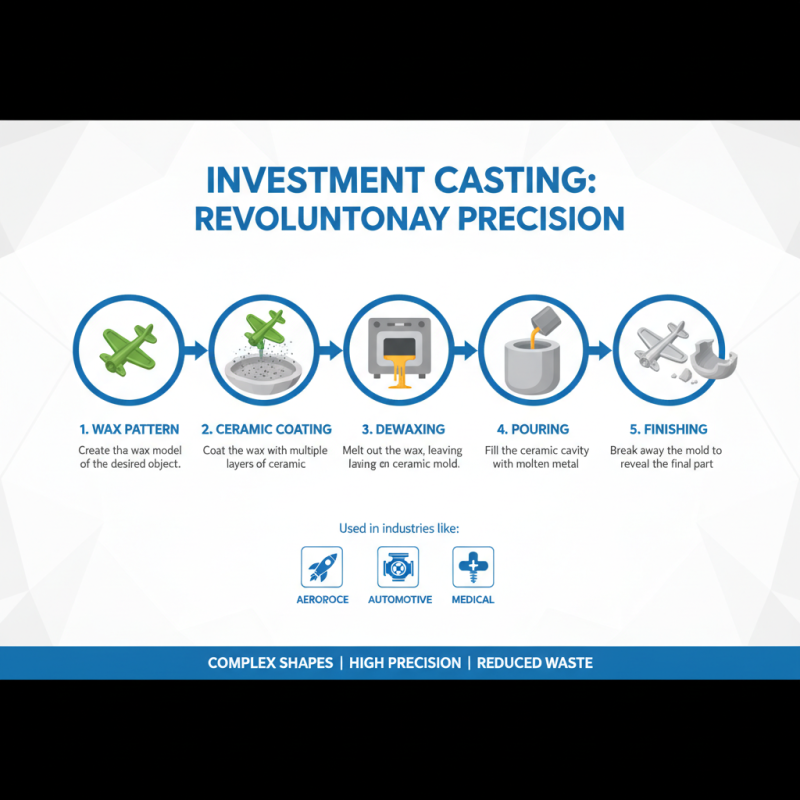
Investment casting is a revolutionary manufacturing process. It allows for the creation of complex shapes with high precision. This technique is widely used in various industries, including aerospace, automotive, and medical. The process begins with a wax pattern, which is coated in ceramic. Once the ceramic hardens, the wax is melted away. This leaves a cavity in the shape of the desired part.
The applications of investment casting are vast. It excels in producing intricate designs and detailed features. For instance, aerospace components can be made lighter yet exceptionally strong. Medical devices benefit from the precision of this technique, improving patient outcomes. However, considerations must be made when selecting parts. Not every design is suitable for investment casting. Some may require adjustments to meet the necessary tolerances.
When choosing parts for investment casting, think critically about design feasibility. Complexity can increase costs and lead time. It's essential to collaborate with experienced foundries to address potential pitfalls early. Feedback from manufacturers can reveal limitations in design. This iterative process can help refine your project. Understanding these nuances is crucial for a successful outcome.
Key Factors to Consider When Choosing Investment Casting Parts
When selecting investment casting parts, there are several key factors to consider. Material choice is crucial. Different metals offer unique properties. For example, aluminum is lightweight, while stainless steel provides strength. Think carefully about what your project needs.
Precision is another important aspect. Casting quality often dictates how well a part will perform. Look for parts with tight tolerances and smooth finishes. Inconsistent dimensions can lead to assembly issues later. Consider also the complexity of the design. More intricate shapes may require advanced tooling.
Cost is a practical consideration. While cheaper options might save money now, they can lead to future complications. Evaluate the long-term value of your investment. Remember, a part that fails can be costly. Balancing quality and budget is often challenging, but vital for project success.
Material Selection for Investment Casting Projects
When selecting materials for investment casting projects, several factors come into play. The type of application often dictates the ideal material. For instance, strength and heat resistance are vital for aerospace components. Here, high-performance alloys can be necessary. On the other hand, a project requiring aesthetic appeal may prioritize appearance over mechanical properties.
Understanding the environmental conditions is also crucial. Certain materials corrode faster in harsh environments. Using stainless steel or other durable alloys might be an option. However, the cost is an important consideration. Cheaper materials may save money upfront, but they could lead to failures later. This could result in higher repair costs and delays.
Experimenting with different materials is essential. Sometimes the best choice is not obvious at first. Testing prototypes can reveal unexpected strengths and weaknesses. Every project is unique, requiring tailored solutions. Reflecting on past experiences can guide future decisions. Selecting materials is not just about following guidelines; it requires a nuanced approach.
How to Choose Investment Casting Parts for Your Project? - Material Selection for Investment Casting Projects
| Material |
Density (g/cm³) |
Tensile Strength (MPa) |
Melting Point (°C) |
Applications |
| Stainless Steel |
7.9 |
515 |
1400-1450 |
Food Industry, Aerospace |
| Carbon Steel |
7.85 |
400 |
1420-1500 |
Construction, Automotive |
| Alloy Steel |
7.85 |
600 |
1300-1400 |
Oil & Gas, Heavy Machinery |
| Bronze |
8.7 |
300 |
900-950 |
Marine Applications, Electrical Components |
| Aluminum |
2.7 |
310 |
660-680 |
Aerospace, Automotive Industry |
Evaluating Quality and Tolerances in Investment Casting Components
When evaluating quality and tolerances in investment casting components, precision is key. Investment casting can achieve tolerances of ±0.005 inches or better. However, achieving these tolerances is not always straightforward. Variations in material properties and design complexity can affect the final dimensions. Continuous monitoring during the casting process can help reduce these variances. According to industry reports, about 15% of parts fail due to tolerance issues.
Material choice also impacts quality. Common alloys used in investment casting include aluminum and stainless steel. Each material has specific properties that influence tolerances. For example, alloys can expand or contract differently during the cooling process. This expansion can lead to dimensional inaccuracies if not accounted for properly.
Moreover, casting defects can arise from various sources. Some defects are minor and may go unnoticed, while others can lead to significant failures. Knowing how to identify these defects is crucial. Statistical process control (SPC) can aid in tracking quality over time. However, reliance solely on statistical methods may overlook nuanced issues. Balancing these approaches can help improve overall casting integrity and reduce rework.
Cost Considerations and Budgeting for Investment Casting Parts
When budgeting for investment casting parts, understanding costs is crucial. According to a recent industry report, the total cost of investment casting can reach up to $30 per pound. This figure includes raw materials, labor, and overhead. Pricing can vary significantly based on production volume. For smaller runs, costs might surge due to setup fees and tooling expenses.
Material choice significantly impacts the budget as well. High-performance alloys often drive up costs. For instance, stainless steel can be 20-50% pricier than aluminum. Project managers must balance material benefits against costs. It's essential to evaluate the performance requirements of each part. Sometimes, opting for a lower-cost material lacks the necessary durability.
The production process itself can introduce complexity. Lead times might stretch from weeks to months, depending on design intricacies. Shorter lead times often incur higher costs. Keeping these factors in mind helps maintain a realistic budget. Projects frequently exceed original estimates, leading to financial strain. Regularly revisiting cost projections can help mitigate overspending.